The Tax-Free Savings Account (TFSA) is one of the most widely used registered accounts available to Canadians – and for good reason. Since the Government of Canada introduced it in 2009, over 16 million Canadians have opened a TFSA. Yet many account holders still do not use it to its full potential.
Whether you are saving for retirement, building an emergency fund, working toward a major purchase, or accumulating long-term wealth, a TFSA can play a meaningful role in your broader financial picture. This guide covers how the TFSA works, how much you can contribute in 2026, what you can hold inside the account, and what approaches Canadians commonly discuss when thinking about this registered account.
Disclaimer: This article is for educational and informational purposes only. It does not constitute financial, tax, investment, or insurance advice. Every individual’s financial situation is unique. Please consult a qualified financial professional before making any financial decisions.
TL;DR – Key Takeaways About the TFSA in Canada
- The 2026 TFSA annual contribution limit is $7,000
- All investment growth and withdrawals are completely tax-free
- TFSA withdrawals do not affect government benefits such as OAS or GIS
- You can hold cash, GICs, ETFs, stocks, mutual funds, and more inside a TFSA
- Unused contribution room carries forward indefinitely
- Available to any Canadian resident aged 18 or older with a valid SIN
- Over-contributing triggers a 1% monthly penalty tax from the CRA
- Using a TFSA alongside an RRSP is often discussed as a tax-efficient approach for many Canadians
What Is a Tax-Free Savings Account (TFSA) and How Does It Work?
A Tax-Free Savings Account (TFSA) is a registered account offered by the Government of Canada that allows you to save and invest money without paying tax on the growth or withdrawals. The “tax-free” designation means that whether your investments grow modestly or significantly over time, no tax is owed when you withdraw.
Unlike non-registered savings accounts, where investment income – such as interest, dividends, and capital gains – is subject to annual taxation, a TFSA shelters all returns from the Canada Revenue Agency (CRA).
Here is how the basic flow works:
- You contribute after-tax dollars into your TFSA
- Your money grows tax-free inside the account
- You withdraw whenever you want – with no tax owing
- Your withdrawn amount is added back to your contribution room on January 1 of the following calendar year
This combination of tax-free growth and withdrawal flexibility is what makes the TFSA a distinct tool among registered accounts in Canada.
TFSA Contribution Limits: How Much Can You Contribute in 2026?
The annual TFSA contribution limit is set by the federal government and indexed to inflation, rounded to the nearest $500. For 2026, the limit remains $7,000.
If you have never opened a TFSA – or have had unused room accumulating over the years – your available contribution room may be considerably higher than $7,000.
Cumulative TFSA Contribution Room by Year
| Year | Annual Limit | Cumulative Lifetime Room (from 2009) |
|---|---|---|
| 2009–2012 | $5,000/year | $20,000 |
| 2013–2014 | $5,500/year | $31,000 |
| 2015 | $10,000 | $41,000 |
| 2016–2018 | $5,500/year | $57,500 |
| 2019–2022 | $6,000/year | $81,500 |
| 2023 | $6,500 | $88,000 |
| 2024–2025 | $7,000/year | $102,000 |
| 2026 | $7,000 | $109,000 |
Important: If you became a Canadian resident after 2009, your contribution room only starts accumulating from the year you turned 18 and established Canadian residency. Always verify your exact available contribution room through your CRA My Account.
You can explore registered account options, including the TFSA, to understand how different accounts may fit into your overall financial picture.
What Can You Hold Inside a TFSA?
One of the most common misconceptions about TFSAs is that they are simply savings accounts. In reality, a TFSA can hold a wide range of eligible investments – making it a flexible wealth-building tool when used to its potential.
Eligible investments inside a TFSA can include:
- Cash and high-interest savings deposits
- GICs (Guaranteed Investment Certificates)
- Mutual funds
- ETFs (Exchange-Traded Funds)
- Canadian and foreign stocks listed on designated exchanges
- Bonds (government and corporate)
- Certain small business corporation shares
The appropriate mix of investments depends on your individual financial goals, time horizon, and comfort with risk. A conservative investor nearing retirement may consider GICs and bond funds, while a younger Canadian with a longer time horizon might look at diversified equity ETF portfolios.
Learn more about TFSA investment options available through Whealth to better understand how this account can be structured around your goals.
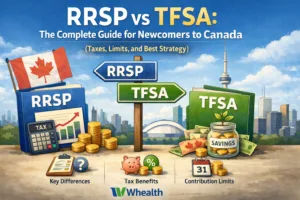
TFSA vs. RRSP: What Is the Difference and Which One Applies to Your Situation?
This is one of the most frequently asked questions among Canadian investors. Both accounts serve different purposes, and many Canadians may find value in using both – depending on their income level and financial goals.
For a full breakdown of how the other major registered account works, read our guide on how the RRSP works in Canada.
Side-by-Side Comparison: TFSA vs. RRSP
| Feature | TFSA | RRSP |
|---|---|---|
| Contributions | After-tax dollars | Pre-tax dollars (tax deduction) |
| Withdrawals | Tax-free, anytime | Taxed as income |
| Contribution room | Unused room carries forward; withdrawals restore room | Unused room carries forward; no restoration on withdrawals |
| Income impact | Does NOT affect OAS, GIS, or income-tested benefits | Withdrawals count as taxable income |
| Age limit | No maximum age | Must convert to RRIF by end of year you turn 71 |
| Often discussed for | Flexibility, lower-income earners, tax-free retirement income | Higher-income earners seeking immediate tax deductions |
General considerations often discussed in Canadian financial planning:
- If your income is roughly below $50,000, prioritizing the TFSA may offer more flexibility
- If your income is roughly above $80,000, the RRSP deduction may provide greater immediate tax value
- If your income falls in between, a combination approach is commonly considered
These are general educational observations only. Individual circumstances vary significantly. A qualified financial professional can help you assess both options based on your specific situation.
Unsure whether a TFSA, RRSP, or a combination approach may suit your situation?
Whealth offers consultations to help Canadians explore registered account options and understand how different accounts may align with their financial goals.
Get started with Whealth today →
TFSA Withdrawal Rules: Can You Take Money Out Anytime?
Yes – and this flexibility is one of the key advantages of the TFSA compared to other registered accounts.
You can withdraw from your TFSA at any time, for any reason, with no tax consequences.
What You Need to Know About TFSA Withdrawal Rules
- Withdrawals are never added to your taxable income
- The amount you withdraw is added back to your contribution room on January 1 of the following year
- You can re-contribute the withdrawn amount starting the next calendar year – not the same year, unless you still have separate unused room available
Illustrative example (hypothetical): Suppose you have $40,000 in your TFSA and withdraw $10,000 in July 2026 for a home renovation. In this scenario, you generally cannot re-contribute that $10,000 until January 1, 2027 – unless you had separate unused contribution room available in 2026. This is where many Canadians inadvertently over-contribute. Tracking your contribution room carefully is essential.
Common TFSA Mistakes to Avoid
Despite being a relatively straightforward account in principle, TFSAs can involve some costly errors. Here are the most important ones to be aware of:
Top TFSA Mistakes to Watch For
- Over-contributing: Contributing more than your available room triggers a 1% per month penalty tax from the CRA on the excess amount – even if the mistake was unintentional.
- Re-contributing in the same year: Withdrawing and re-contributing in the same calendar year (without having separate unused room) is one of the most common over-contribution traps.
- Holding only cash: Many Canadians open a TFSA at a bank and leave it as a plain savings deposit. This limits the tax-sheltering potential of the account to minimal interest income.
- Not opening a TFSA at all: Every year without a TFSA means money that could be growing in a tax-sheltered environment is instead sitting in a taxable account.
- Ignoring foreign withholding taxes: U.S. dividend-paying stocks held in a TFSA may be subject to a 15% U.S. withholding tax – an important consideration for those building equity portfolios inside the account.
Common Ways Canadians Use Their TFSA in 2026
Using a TFSA thoughtfully can meaningfully support long-term financial goals. Below are several approaches that are commonly discussed in Canadian financial planning circles.
Option 1: Use Your TFSA as a Source of Tax-Free Retirement Income
In retirement, TFSA withdrawals do not count as income. This means they will not trigger clawbacks of your Old Age Security (OAS) or Guaranteed Income Supplement (GIS). For many retirees, drawing from a TFSA before an RRSP or RRIF may help reduce total taxes paid over a lifetime – though individual circumstances vary considerably.
Option 2: Consider Holding Growth-Oriented Assets Inside Your TFSA
Because capital gains inside a TFSA are not taxed, some Canadians choose to hold growth-focused investments there. ETFs tracking diversified indices are a common example discussed in Canadian financial media – though any investment decision should reflect your personal risk tolerance, time horizon, and financial goals.
Option 3: Build an Emergency Fund With a High-Interest TFSA
A high-interest TFSA savings account can earn more than a standard savings account while keeping your emergency fund fully accessible – with no tax on interest earned. This may suit those who prioritize capital preservation and liquidity.
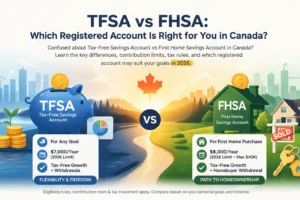
Option 4: Explore the FHSA If You Are Saving for a First Home
If saving for your first home is your primary financial goal, the First Home Savings Account (FHSA) may be worth exploring alongside or before the TFSA. The FHSA combines RRSP-style tax deductions with TFSA-style tax-free withdrawals, specifically designed for first-time home buyers in Canada.
TFSA Use Case Overview
| Financial Goal | TFSA Suitability | Notes |
|---|---|---|
| Retirement income | High | Withdrawals do not affect OAS/GIS |
| Emergency fund | High | Flexible access, tax-free interest |
| First home purchase | Moderate | Consider FHSA first if eligible |
| Education savings | Moderate | Consider RESP for government grants |
| General wealth accumulation | High | Tax-free growth over time |
| Short-term savings goal | Moderate | Accessible without tax consequences |
Illustrative Scenario: How a TFSA Might Fit Into a Canadian’s Financial Plan
The following is a hypothetical scenario created for educational purposes only. It does not represent a real individual, and no outcomes are implied or guaranteed.
Consider Maria, a 34-year-old registered nurse in Ontario earning approximately $85,000 per year. She had been contributing to her employer’s group pension plan but had never opened a TFSA, assuming it was “just a savings account.”
After speaking with a financial advisor, Maria learned she had accumulated over $60,000 in unused TFSA contribution room since 2009. Her personal savings had been sitting in a regular bank account, where interest income was taxed annually.
With guidance from her advisor, Maria explored the possibility of:
- Opening a self-directed TFSA with a diversified portfolio of low-cost ETFs
- Contributing a lump sum from existing savings
- Setting up automatic monthly contributions
- Understanding how TFSA withdrawals in retirement could potentially help protect her OAS benefits
In this illustrative scenario, having unused contribution room meant Maria had significant flexibility to reorganize her savings into a more tax-efficient structure – without incurring immediate tax consequences.
Investment returns are not guaranteed. Past performance does not predict future results. This example uses hypothetical figures for illustration only. Always consult a qualified financial professional before making any financial decisions.
Ready to explore how a TFSA might fit into your broader financial picture?
Whealth offers a free first consultation to help Canadians understand registered account options and financial planning considerations.
Book your free consultation with Whealth →
TFSA for Small Business Owners in Canada
If you own a small business in Canada, the TFSA can be a particularly relevant personal finance tool. Unlike an RRSP, TFSA contributions are not tied to employment income – which may matter when your business income fluctuates from year to year.
Why Small Business Owners Often Discuss TFSAs
- No earned income requirement: Even in a lower-income year, you may still be able to contribute to your TFSA (subject to available room)
- Tax-free accumulation outside the corporation: Keeps personal wealth growing separately from business finances
- Flexibility: Funds can be accessed without triggering taxable income, which may be useful for managing personal cash flow
- No impact on income-tested benefits: May help protect access to certain government support programs
Small business owners exploring broader financial protection may also want to learn about life insurance in Canada and review group insurance options for small businesses to complement their investment planning. You can explore the full range of financial solutions on the Whealth products page.
Conclusion: The TFSA Is One of Canada’s Most Accessible Financial Tools – Are You Using It?
The Tax-Free Savings Account (TFSA) is not just a place to park savings. Used thoughtfully, it is a tax-sheltered registered account that may support long-term wealth accumulation while giving you the flexibility to access your money when needed – without triggering a tax bill.
Whether you are building an emergency fund, planning for retirement, saving for a major goal, or managing personal finances as a small business owner, the TFSA is widely considered a valuable component of a broader financial plan. Understanding how contribution room accumulates, what you can hold inside the account, and how withdrawals work can help you use this tool more effectively.
The challenge many Canadians face is knowing how to apply these principles to their own unique situation – and that is where speaking with a qualified professional can make a meaningful difference.
Interested in learning how a TFSA and other registered accounts may fit into your financial plan?
Whealth can help you explore investment and insurance options relevant to your goals and situation.
Start exploring your options with Whealth →
This article is intended for educational purposes only and does not constitute financial, tax, investment, or insurance advice. Please consult a qualified financial professional before making any financial decisions.
Frequently Asked Questions
Find answers to common questions about this topic
The annual TFSA contribution limit for 2026 is $7,000, as set by the Government of Canada. If you have never contributed to a TFSA, or have carried forward unused room from previous years, your total available contribution room may be as high as $109,000 - assuming you were a Canadian resident aged 18 or older in 2009. Always verify your exact room through your CRA My Account.
Yes. TFSA withdrawals can be made at any time, for any reason, with no tax consequences. The amount you withdraw is added back to your contribution room on January 1 of the following calendar year. Importantly, you cannot re-contribute a withdrawal in the same calendar year unless you have separate unused room available - doing so may trigger an over-contribution penalty from the CRA.
A TFSA can hold a wide range of eligible investments, including cash, GICs (Guaranteed Investment Certificates), mutual funds, ETFs (Exchange-Traded Funds), Canadian and foreign stocks listed on designated exchanges, bonds, and certain small business corporation shares. It is not limited to a plain savings deposit, which is a common misconception.
No. TFSA withdrawals do not count as taxable income, which means they have no impact on income-tested federal benefits such as Old Age Security (OAS) or the Guaranteed Income Supplement (GIS). This is one of the key distinctions between a TFSA and an RRSP, where withdrawals are counted as taxable income.
The main difference lies in when the tax benefit applies. RRSP contributions are made with pre-tax dollars and provide an immediate tax deduction, but withdrawals are taxed as income. TFSA contributions are made with after-tax dollars and offer no upfront deduction, but all growth and withdrawals are completely tax-free. Many Canadians use both accounts for different financial goals, depending on their income level and retirement planning needs.
Related Articles