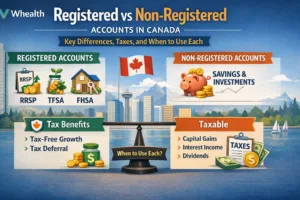
If you are new to Canada and trying to understand how to save money in a tax-efficient way, two registered accounts will likely come up almost immediately: the RRSP (Registered Retirement Savings Plan) and the TFSA (Tax-Free Savings Account). According to Statistics Canada, over 300,000 permanent residents arrive in Canada each year – and a significant portion of them are unfamiliar with the Canadian registered account system. Understanding the structural differences between these two accounts is one of the most important educational steps any newcomer can take when beginning to build financial knowledge in Canada.
This guide explains how each account works, how they differ, and what newcomers should generally be aware of – all in plain, accessible language.
Disclaimer: This content is for educational purposes only and does not constitute financial, investment, tax, or insurance advice. Always consult a qualified professional for guidance tailored to your personal situation.
TL;DR – Key Takeaways
- RRSP contributions may reduce your taxable income; withdrawals are generally taxed as income.
- TFSA contributions do not reduce taxable income; withdrawals are generally tax-free.
- Both accounts can hold a variety of investments, including savings deposits, mutual funds, ETFs, and GICs.
- Newcomers may be eligible for a TFSA immediately upon becoming a Canadian resident at age 18+.
- RRSP contribution room is based on prior-year earned income reported in Canada.
- Both accounts have annual contribution limits set by the Canada Revenue Agency (CRA).
- Using both accounts together is a common approach to tax-efficient saving in Canada.
- Consult a qualified financial professional before making decisions about which account to use.
What Is the RRSP and How Does It Work in Canada?
The Registered Retirement Savings Plan (RRSP) is a government-registered account designed to help Canadians save for retirement while potentially reducing their tax burden today. When you contribute to an RRSP, the amount contributed may be deducted from your taxable income for that year – which can lower your income tax owing.
Investment growth inside an RRSP is tax-deferred, meaning you do not pay tax on earnings while they remain in the account. However, when you withdraw funds – whether in retirement or earlier – those withdrawals are included in your taxable income for that year.
For a deeper look at how this account functions, see our complete guide to how the RRSP works in Canada.
Key RRSP Features at a Glance
| Feature | Details |
|---|---|
| Contribution Limit (2026) | 18% of prior year’s earned income, up to $32,490 |
| Contribution Deadline | 60 days after the end of the calendar year (March 1 or February 29 for leap years) |
| Tax on Contributions | Contributions may be deducted from taxable income |
| Tax on Growth | Tax-deferred (not taxed while inside the account) |
| Tax on Withdrawals | Withdrawals included in taxable income |
| Account Maturity | Must be converted or collapsed by December 31 of the year you turn 71 |
| Eligible Investments | Savings deposits, GICs, mutual funds, ETFs, bonds, stocks (eligible securities) |
Newcomer Note: Your RRSP contribution room is based on earned income you have reported through the Canadian tax system. If you are in your first year of filing a Canadian tax return, your contribution room for that year will be calculated based on the income you report. Prior foreign income is generally not included in RRSP room calculations.
What Is the TFSA and How Does It Work in Canada?
The Tax-Free Savings Account (TFSA) is a registered account that allows Canadian residents aged 18 and older to save and invest money without paying tax on the growth or withdrawals. Unlike the RRSP, contributions to a TFSA are made with after-tax dollars – meaning there is no immediate tax deduction when you contribute.
However, the significant benefit is that all growth and withdrawals are generally tax-free. You can withdraw your funds at any time for any purpose without triggering a tax bill. The amount you withdraw is also added back to your contribution room the following January 1.
For a full breakdown, read our complete guide to the TFSA in Canada.
Key TFSA Features at a Glance
| Feature | Details |
|---|---|
| Annual Contribution Limit (2026) | $7,000 |
| Cumulative Lifetime Room (2026) | $102,000 (for those eligible since 2009) |
| Tax on Contributions | No deduction – contributions made with after-tax dollars |
| Tax on Growth | Tax-free |
| Tax on Withdrawals | Generally tax-free |
| Withdrawal Room Restored | Yes – the following January 1 |
| Account Maturity | No mandatory conversion age |
| Eligible Investments | Savings deposits, GICs, mutual funds, ETFs, bonds, stocks (eligible securities) |
Newcomer Note: TFSA contribution room begins accumulating from the later of: the year you turned 18, or the year you became a Canadian resident. If you arrived in Canada in 2023 at age 30, your TFSA room began accumulating in 2023 – not retroactively from 2009.
RRSP vs TFSA: What’s the Core Difference?
The fundamental difference between the RRSP and TFSA comes down to when you receive the tax benefit:
- RRSP: You receive a tax benefit now (deduction on contributions), but pay tax later (on withdrawals).
- TFSA: You do not receive a tax deduction now, but pay no tax later on growth or withdrawals.
This distinction is especially important for newcomers to Canada, because your current income level and expected future income level can influence which account may be more tax-efficient for your situation. A qualified tax professional can help you think through this based on your specific circumstances.
Side-by-Side Comparison: RRSP vs TFSA for Newcomers
| Comparison Point | RRSP | TFSA |
|---|---|---|
| Tax deduction on contribution | Yes | No |
| Tax on investment growth | Deferred | Tax-free |
| Tax on withdrawals | Yes (as income) | No |
| Contribution room source | 18% of prior year Canadian earned income | Annual limit set by CRA ($7,000 in 2026) |
| Room accumulation for newcomers | Based on Canadian income history | From year of Canadian residency (age 18+) |
| Withdrawal flexibility | Limited (tax consequences apply) | High (flexible, room restored next year) |
| Best commonly associated purpose | Retirement savings | Flexible short- or long-term savings |
| Account deadline | Must convert by age 71 | No mandatory conversion |
| Spousal contribution option | Yes (Spousal RRSP available) | No spousal contribution option |
What Can You Hold Inside an RRSP or TFSA?
Both the RRSP and TFSA are registered account types, not investment products themselves. This is a common point of confusion for newcomers. You can hold a range of eligible investments inside either account, including:
- Cash and high-interest savings deposits
- Guaranteed Investment Certificates (GICs) – fixed-term deposits that earn interest
- Mutual funds – pooled investment funds managed by professionals
- Exchange-Traded Funds (ETFs) – funds that track an index, traded on a stock exchange
- Stocks and bonds (eligible securities listed on designated exchanges)
The specific investments you hold within the account do not change the tax treatment of the account itself. The account wrapper (RRSP or TFSA) determines how contributions, growth, and withdrawals are taxed.
To explore investment account options further, visit the registered accounts overview on Whealth.
Common Questions Newcomers Have About RRSP and TFSA Eligibility
Can I open a TFSA as soon as I arrive in Canada?
Generally, yes – if you are at least 18 years old and a Canadian resident for tax purposes, you may be eligible to open a TFSA. Your contribution room begins accumulating from the year you establish Canadian residency. It is important to understand that non-residents of Canada who hold a TFSA may be subject to a 1% per month tax on contributions made during non-residency periods, according to the Canada Revenue Agency.
When Can I Start Contributing to an RRSP as a Newcomer?
Your RRSP contribution room is based on earned income you have reported in Canada. Specifically, you can accumulate room from the first year you file a Canadian tax return with earned income. The contribution room is equal to 18% of your prior year’s earned income in Canada, up to the annual maximum ($32,490 in 2026). If you have just arrived and had no Canadian income in your first year, you may have little to no RRSP room initially.
Does Foreign Income Count Toward RRSP Contribution Room?
Generally, no. According to the Canada Revenue Agency, RRSP contribution room is calculated based on earned income reported for Canadian tax purposes. Income earned abroad before becoming a Canadian resident is generally not included. Some newcomers may also have pension adjustments from foreign pension plans to consider – a qualified tax advisor can help clarify your specific situation.
Illustrative Scenario: A Newcomer Navigating RRSP and TFSA Decisions
The following is a hypothetical, illustrative example for educational purposes only. It does not represent real individuals or specific advice.
Background: Priya arrived in Canada from India in January 2024 at age 32. She secured employment as a software developer with an annual salary of approximately $85,000. In her first year, she was not sure which registered account to open first.
The Educational Challenge: Priya was unfamiliar with the Canadian registered account system. She initially assumed her RRSP contribution room would reflect her 10+ years of work experience abroad – but learned that her room would only begin accumulating based on her 2024 Canadian income. She also did not realize that her TFSA room began accumulating from 2024, not from 2009 like a Canadian-born resident of the same age.
What She Learned: After speaking with a qualified financial professional and reviewing CRA resources, Priya understood that:
- Her TFSA room for 2024 and 2025 was $7,000 per year (cumulative $14,000 by 2025).
- Her RRSP room for 2025 (based on 2024 income) was approximately $15,300 (18% of $85,000).
- Both accounts could hold similar investments, but had different tax implications.
- She could potentially use both accounts as part of her long-term saving plan.
Outcome of the Educational Process: By understanding the mechanics of both accounts, Priya was able to make a more informed decision about how to allocate her savings – with the support of a qualified professional who understood her full financial picture.
This scenario is illustrative only. Individual circumstances vary significantly.
Other Registered Accounts Newcomers Should Know About
While the RRSP and TFSA are the two most commonly discussed registered accounts, newcomers to Canada may also want to become familiar with:
- First Home Savings Account (FHSA): A registered account that combines features of both the RRSP and TFSA, designed for first-time home buyers. Contributions may be tax-deductible, and qualifying withdrawals for a first home purchase are generally tax-free.
- Registered Education Savings Plan (RESP): Designed to save for a child’s post-secondary education. The Canadian government may provide grants through the Canada Education Savings Grant (CESG).
- Registered Disability Savings Plan (RDSP): Available for Canadians eligible for the Disability Tax Credit. The government may contribute through grants and bonds.
- Non-registered savings accounts: Accounts that do not have registered status, with no contribution limits but no special tax sheltering.
You can explore the full range of registered account options available through Whealth’s investment section.
New to Canada and unsure where to start with registered accounts?
Whealth offers educational resources and access to qualified professionals who can walk you through your options based on your individual situation.
Learn more about registered account options:
Explore Registered Accounts at Whealth →
How Do RRSP and TFSA Withdrawals Work?
Understanding withdrawal rules is essential – especially for newcomers who may need flexible access to their savings during a period of financial adjustment.
RRSP Withdrawal Rules
- Withdrawals from an RRSP are generally included in your taxable income for the year of withdrawal.
- A withholding tax is typically applied at the time of withdrawal (10%–30% depending on the amount), as required by the CRA.
- Withdrawn RRSP contribution room is not restored – once you withdraw, that room is gone permanently.
- There are two notable exceptions: the Home Buyers’ Plan (HBP), which may allow tax-free RRSP withdrawals for a first home purchase (subject to repayment conditions), and the Lifelong Learning Plan (LLP), which may allow withdrawals for qualifying education expenses.
TFSA Withdrawal Rules
- Withdrawals from a TFSA are generally not included in taxable income.
- There is no withholding tax on TFSA withdrawals.
- The amount withdrawn is added back to your contribution room on January 1 of the following calendar year.
- There are no restrictions on what you can use TFSA withdrawals for.
Important: Over-contributing to either account can result in penalty taxes. The CRA charges a 1% per month penalty on TFSA over-contributions. Always verify your available contribution room through your CRA My Account before contributing.
Which Registered Account Might Be More Relevant for a Newcomer?
This is one of the most common questions newcomers ask – and the honest answer is that it depends on individual circumstances. There is no universally applicable answer. However, there are some educational considerations that financial professionals commonly discuss:
TFSA may be particularly relevant early on because:
- Contribution room starts accumulating from the year of Canadian residency (not retroactively).
- It does not require prior Canadian earned income to generate room.
- Withdrawals are flexible and tax-free, which may be helpful during a period of financial adjustment.
- Unused TFSA room carries forward indefinitely.
RRSP may become more relevant as Canadian income grows because:
- Higher earners may benefit more from the upfront tax deduction.
- RRSP room accumulates based on Canadian earned income, growing over time as you work in Canada.
- RRSP contributions can potentially be deferred and claimed in a future higher-income year for a larger deduction.
Both accounts serve different purposes and are not mutually exclusive. Many Canadians use both as part of their overall financial planning. A qualified financial or tax professional can help you think through which approach may align with your situation.
Want to learn more about how registered accounts may fit into your financial planning?
Explore educational resources and speak with a qualified professional through Whealth.
Book a consultation:
Schedule a Free 1-Hour Consultation with a Whealth Advisor →
RRSP vs TFSA: A Quick Summary for Newcomers
Here is a simplified overview to help consolidate the key educational points:
RRSP – Key Points for Newcomers:
- Contribution room is based on prior-year Canadian earned income (18%, up to $32,490 in 2026).
- Contributions may reduce your taxable income in the year claimed.
- Investment growth inside is tax-deferred – not taxed until withdrawal.
- Withdrawals are generally taxed as income.
- Designed primarily for long-term retirement savings.
- Must be converted to an RRIF or annuity by age 71.
TFSA – Key Points for Newcomers:
- Room accumulates from the year you become a Canadian resident (at age 18+).
- Contributions are made with after-tax dollars – no deduction.
- Investment growth is tax-free.
- Withdrawals are generally tax-free, with room restored the following year.
- Highly flexible – can be used for any savings goal.
- No mandatory conversion age.
Conclusion
For newcomers to Canada, understanding the difference between the RRSP and TFSA is a foundational step in building financial literacy within the Canadian system. Both accounts offer meaningful potential tax benefits – they simply work in opposite directions. The RRSP provides a tax benefit today through deductible contributions, while the TFSA provides a tax benefit later through tax-free growth and withdrawals.
Neither account is universally “better” – the right approach depends entirely on your individual income, timeline, residency history, and financial goals. What matters most is taking the time to understand how each account works and speaking with a qualified financial or tax professional who can help you think through the options relevant to your situation.
To explore registered savings account options available in Canada, visit Whealth’s registered accounts section.
Ready to explore your registered account options in Canada?
Whealth provides access to educational resources and qualified professionals who can walk you through the Canadian registered account landscape.
Get started:
Explore Your Options with Whealth →
This content is for educational purposes only and does not constitute financial, investment, tax, or insurance advice. Always consult a qualified professional for guidance tailored to your personal situation.
Frequently Asked Questions
Find answers to common questions about this topic
Yes, newcomers who are Canadian residents and have filed a Canadian tax return may be eligible to open both accounts. TFSA eligibility begins at age 18, while RRSP eligibility requires Canadian earned income. It is worth consulting a qualified financial professional to understand how your residency status affects your eligibility.
The TFSA contribution limit for 2026 is $7,000, bringing the cumulative lifetime limit to $102,000 for those who have been eligible since 2009. However, your personal limit depends on your specific residency history and prior contributions. Check your available room through your CRA My Account.
RRSP contributions may reduce your taxable income for the year in which they are made, which can lower the amount of income tax you owe. The amount deducted depends on your contribution room, which is based on your prior year's earned income. This is a commonly cited benefit of using an RRSP for retirement savings.
TFSA withdrawals are generally not subject to income tax, and the withdrawn amount is added back to your contribution room the following calendar year. RRSP withdrawals, on the other hand, are typically included in your taxable income for that year. This is one of the key structural differences between the two accounts.
The TFSA is commonly considered more flexible for short-term savings goals because withdrawals are not taxed and the contribution room is restored the following year. The RRSP is generally designed with long-term retirement savings in mind, and early withdrawals may carry tax consequences. Always consult a qualified professional before making withdrawal decisions.
Related Articles