For the 2026 tax year, the Canada Revenue Agency (CRA) has updated key contribution limits for registered accounts including the RRSP, TFSA, FHSA, and RESP. Understanding these numbers – and how each account is treated under the Canadian tax system – can help you make more informed decisions about your savings and financial planning options.
According to the CRA, the RRSP dollar limit has risen to $32,490 for 2026, while the TFSA annual contribution limit remains at $7,000. Whether you are saving for retirement, your first home, or your child’s education, knowing the current rules is an important starting point.
Disclaimer: This content is for educational purposes only and does not constitute financial, investment, tax, or insurance advice. Always consult a qualified professional for guidance tailored to your personal situation.
TL;DR – Key Takeaways for 2026
- RRSP limit 2026: $32,490 (up from $31,560 in 2025)
- TFSA limit 2026: $7,000 (unchanged from 2024–2025)
- FHSA annual limit: $8,000 per year, $40,000 lifetime
- RESP lifetime limit: $50,000 per beneficiary (no annual cap)
- Unused RRSP and TFSA contribution room carries forward
- FHSA contributions are tax-deductible; withdrawals for a qualifying home purchase are tax-free
- Non-registered accounts are subject to annual tax on interest, dividends, and capital gains
- Both RRSP and FHSA can potentially be used together for a first home purchase
What Is the RRSP Contribution Limit for 2026?
The RRSP (Registered Retirement Savings Plan) contribution limit for 2026 is $32,490 – an increase of $930 from the 2025 limit of $31,560. This annual dollar limit is set by the CRA and indexed to the average wage growth in Canada.
Your personal RRSP deduction limit is calculated as:
- 18% of your prior year’s earned income, up to the annual dollar limit
- Plus any unused RRSP room carried forward from previous years
- Minus any pension adjustments (PA) reported by your employer
The CRA provides your exact deduction limit on your Notice of Assessment (NOA) or through your CRA My Account portal.
Important: The RRSP contribution deadline for the 2025 tax year is March 2, 2026. Contributions made before this date may be deducted on your 2025 tax return.
To explore more about contribution room, deduction rules, and how RRSPs work, see this detailed guide on how the RRSP works in Canada.
RRSP Contribution Limit History (Recent Years)
| Tax Year | RRSP Dollar Limit |
|---|---|
| 2022 | $29,210 |
| 2023 | $30,780 |
| 2024 | $31,560 |
| 2025 | $31,560 |
| 2026 | $32,490 |
Source: Canada Revenue Agency
What Is the TFSA Contribution Limit for 2026?
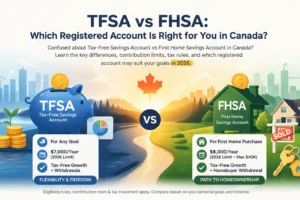
The TFSA (Tax-Free Savings Account) annual contribution limit for 2026 is $7,000, unchanged from 2024 and 2025. The TFSA limit is indexed to inflation in $500 increments, meaning it does not change every year unless inflation reaches the next threshold.
For Canadians who have been eligible since the TFSA was introduced in 2009 and have never contributed, the total cumulative contribution room available in 2026 is $102,000.
Cumulative TFSA Contribution Room (2009–2026)
| Period | Annual Limit | Cumulative Total |
|---|---|---|
| 2009–2012 | $5,000/yr | $20,000 |
| 2013–2014 | $5,500/yr | $31,000 |
| 2015 | $10,000 | $41,000 |
| 2016–2018 | $5,500/yr | $57,500 |
| 2019–2022 | $6,000/yr | $81,500 |
| 2023 | $6,500 | $88,000 |
| 2024–2025 | $7,000/yr | $95,000 |
| 2026 | $7,000 | $102,000 |
Source: Canada Revenue Agency
Key features of the TFSA include:
- Withdrawals are tax-free at any time
- Withdrawn amounts are added back to your contribution room the following calendar year
- Investment growth inside the TFSA is not taxed
- Overcontributions are penalized at 1% per month by the CRA
For a comprehensive breakdown of TFSA contribution rules and eligible investments, refer to Whealth’s full TFSA guide.
Want to understand which registered account may suit your situation?
Whealth offers educational resources and consultations to help Canadians explore their options.
Explore your options with Whealth →
What Are the FHSA Contribution Rules for 2026?
The First Home Savings Account (FHSA) was introduced in 2023 and has quickly become one of the most discussed registered accounts for first-time home buyers in Canada.
For 2026, the FHSA rules remain as follows:
- Annual contribution limit: $8,000
- Lifetime contribution limit: $40,000
- Unused annual room carry-forward: Up to $8,000 (one year only)
- Contributions are tax-deductible (similar to an RRSP)
- Qualifying withdrawals are tax-free (similar to a TFSA)
Who Is Eligible for an FHSA?
To open an FHSA, you must:
- Be a Canadian resident
- Be at least 18 years old
- Be a first-time home buyer (you have not owned a qualifying home in the current year or in any of the four preceding calendar years)
- Have a valid Social Insurance Number (SIN)
The FHSA is a unique account because it combines two major tax benefits – a deduction on contribution and a tax-free withdrawal – making it a notable option for those planning to purchase their first home.
For a complete breakdown of how this account functions, read the FHSA complete 2026 guide from Whealth.
RRSP vs FHSA in 2026: What Are the Key Rule Differences?
Both the RRSP and FHSA offer tax-deductible contributions, but they are designed for different goals. Understanding the differences may help you determine how each account could fit into your overall savings approach.
RRSP vs FHSA – Side-by-Side Comparison (2026)
| Feature | RRSP | FHSA |
|---|---|---|
| Purpose | Retirement savings | First home purchase |
| 2026 Annual Limit | $32,490 (or 18% of earned income) | $8,000 |
| Lifetime Limit | No fixed lifetime cap | $40,000 |
| Tax Deduction on Contribution | Yes | Yes |
| Tax on Withdrawal | Yes (added to income) | No (if qualifying) |
| Unused Room Carry-Forward | Yes (indefinitely) | Yes (one year only) |
| Withdrawal Flexibility | Limited (RRSP HBP for homes; otherwise taxable) | Flexible for first home purchase |
| Maximum Account Lifespan | Must convert to RRIF by age 71 | Must close by Dec 31 in the year you turn 71, or after 15 years |
Source: Canada Revenue Agency
One important planning consideration: eligible Canadians can use both the FHSA and the RRSP Home Buyers’ Plan (HBP) simultaneously when purchasing a qualifying first home. This allows a potential combination of up to $40,000 (FHSA) plus $35,000 (HBP from RRSP) = $75,000 in tax-advantaged funds toward a down payment, subject to eligibility conditions.
What Are the RESP Rules for 2026?
The Registered Education Savings Plan (RESP) continues to be a commonly used vehicle for saving toward a child’s post-secondary education in Canada.
Key RESP rules for 2026:
- Lifetime contribution limit: $50,000 per beneficiary
- No annual contribution limit
- Canada Education Savings Grant (CESG): The federal government may contribute 20% on the first $2,500 contributed per year (up to $500 annually, $7,200 lifetime), subject to eligibility
- Additional CESG: Families with lower net income may qualify for additional grant amounts
- Canada Learning Bond (CLB): Up to $2,000 for eligible lower-income families, with no personal contribution required
- Investment growth inside the RESP is tax-deferred
- Educational Assistance Payments (EAPs) are taxed in the hands of the student when withdrawn
Contributions to an RESP are not tax-deductible, but the account’s investment growth is sheltered from tax until withdrawal. Since students typically have lower income, the tax impact on EAPs is often minimal.
For a thorough overview of eligibility and withdrawal rules, see the guide on how the RESP works for 2026.
Looking to learn more about registered accounts available in Canada?
Whealth provides educational resources and one-on-one consultations to help you explore options that may align with your goals.
Book a free consultation with a Whealth advisor →
Non-Registered vs Registered Accounts: How Is Investment Income Taxed in 2026?
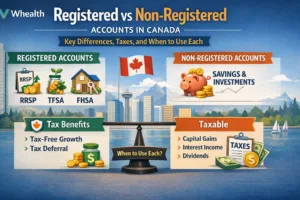
Understanding the tax treatment of different account types is an important part of financial literacy in Canada. The differences between registered and non-registered accounts in Canada go beyond just contribution limits – they also affect how and when you pay tax on your investment growth.
How Investment Income Is Taxed
In registered accounts (RRSP, TFSA, FHSA, RESP):
- Investment growth is either tax-deferred (RRSP, RESP) or tax-free (TFSA, FHSA qualifying withdrawals)
- You do not report annual investment income in these accounts on your tax return
In non-registered accounts:
- Interest income – 100% included in taxable income, taxed at your marginal rate
- Canadian eligible dividends – subject to the dividend gross-up and dividend tax credit mechanism
- Capital gains – only a portion (the inclusion rate) is included in taxable income; the applicable inclusion rate may vary based on legislation in effect at the time
- Foreign income – fully taxable as income; foreign withholding taxes may apply
For many Canadians, the primary appeal of registered accounts is precisely this tax advantage. However, non-registered accounts have their own role – particularly when registered contribution room has been exhausted or when investment flexibility is needed. Explore more on how non-registered saving accounts in Canada fit into broader savings planning.
Summary: Tax Treatment by Account Type (2026)
| Account | Tax on Contribution | Tax on Growth | Tax on Withdrawal |
|---|---|---|---|
| RRSP | Deductible | Tax-deferred | Yes (added to income) |
| TFSA | Not deductible | Tax-free | No |
| FHSA | Deductible | Tax-deferred | No (qualifying purchase) |
| RESP | Not deductible | Tax-deferred | EAPs taxed in student’s hands |
| Non-Registered | Not deductible | Taxed annually | Varies by income type |
Illustrative Scenario: How a Canadian Might Think About Account Selection in 2026
The following is a hypothetical, illustrative example for educational purposes only. It does not represent real individuals or specific financial advice.
Scenario: A 32-year-old Canadian professional earning $90,000 annually is trying to understand how to organize their savings in 2026. They have three goals: saving for retirement, purchasing their first home in the next few years, and building an emergency fund.
Illustrative approach they might explore with a qualified professional:
- They may consider maximizing FHSA contributions ($8,000) first, given the combined tax deduction and tax-free withdrawal potential for a first home
- They might then consider TFSA contributions ($7,000) for their emergency fund and flexible savings, since withdrawals are not taxed and room is restored the following year
- With remaining capacity, they could explore RRSP contributions for long-term retirement savings, particularly if they expect to be in a lower tax bracket in retirement
- Any savings beyond registered room may be explored through a non-registered account
This illustrative example shows why the order in which accounts are used – and the interaction between them – is often a key consideration in financial planning discussions.
Always consult a qualified financial advisor or tax professional before making decisions about your savings accounts.
Conclusion
The 2026 updates to registered plans – including the increased RRSP limit, the stable TFSA room, and the continued availability of the FHSA – reflect an evolving Canadian tax landscape. For individuals and families across Canada, staying informed about these CRA rules is an important part of making thoughtful, educated decisions about savings and tax planning.
Whether you are exploring retirement savings through an RRSP, building flexibility with a TFSA, saving for your first home through an FHSA, or planning for a child’s education through an RESP, each registered account has distinct rules and potential benefits worth understanding.
Whealth is here to provide educational support and connect you with qualified professionals who can help you explore options suited to your goals.
Ready to explore your registered account options for 2026?
Whealth can help you learn more and connect with an advisor who understands the Canadian financial landscape.
Get started with Whealth today →
Disclaimer: This content is for educational purposes only and does not constitute financial, investment, tax, or insurance advice. Contribution limits and CRA rules referenced in this article are based on information available at the time of writing. Always consult a qualified financial advisor or tax professional for guidance tailored to your personal situation.
Frequently Asked Questions
Find answers to common questions about this topic
The Canada Revenue Agency (CRA) has set the TFSA annual contribution limit at $7,000 for 2026, the same as 2024 and 2025. If you have never contributed to a TFSA since you became eligible, your total cumulative room may be significantly higher. Always verify your personal contribution room through your CRA My Account.
For the 2026 tax year, the RRSP dollar limit is $32,490 - an increase from the 2025 limit of $31,560. Your personal deduction limit is generally 18% of your previous year's earned income, up to this maximum, plus any unused room carried forward. The CRA provides your exact limit on your Notice of Assessment.
Yes, eligible Canadians can hold both an RRSP and an FHSA simultaneously. Both accounts offer tax-deductible contributions, but they serve different purposes - the FHSA is specifically designed for first-time home buyers. When you make a qualifying home purchase, you may withdraw from both your FHSA and your RRSP Home Buyers' Plan (HBP) in the same transaction.
A Registered Education Savings Plan (RESP) allows you to save for a child's post-secondary education with tax-deferred growth. The lifetime contribution limit remains $50,000 per beneficiary, and there is no annual contribution limit. The federal government may provide the Canada Education Savings Grant (CESG) of up to 20% on the first $2,500 contributed annually, subject to eligibility conditions.
In registered accounts such as TFSAs, RRSPs, and FHSAs, investment growth is either tax-free or tax-deferred depending on the account type. In non-registered accounts, investment income - including interest, dividends, and capital gains - is subject to annual taxation at applicable Canadian federal and provincial rates. The inclusion rate for capital gains and the dividend tax credit rules can vary, so it is recommended to consult a qualified tax professional.
Related Articles