Disclaimer: This content is for educational purposes only and does not constitute financial, investment, tax, or insurance advice. Always consult a qualified professional for guidance tailored to your personal situation.
Most Canadians glance at the “net pay” line on their pay stub and move on – but understanding every line above it can make a real difference to your financial awareness. According to the Canada Revenue Agency (CRA), payroll deductions in Canada include mandatory contributions to the Canada Pension Plan (CPP), Employment Insurance (EI), and federal and provincial income tax, all of which are calculated automatically by your employer on every pay period. If you have ever wondered why your take-home pay is noticeably lower than your agreed salary, this guide breaks down each deduction in plain language.
TL;DR – Key Takeaways
- Gross pay is what you earn before deductions; net pay is what lands in your bank account.
- Mandatory deductions include CPP contributions, EI premiums, and federal and provincial income tax.
- Voluntary deductions may include group benefits premiums, RRSP contributions, union dues, and pension plan contributions.
- Your TD1 form directly controls how much income tax your employer withholds.
- Once CPP and EI annual maximums are reached, those deductions stop for the rest of the calendar year – which is why your net pay can increase later in the year.
- Understanding your pay stub helps you spot errors, plan your budget, and maximize registered accounts.
What Information Appears on a Canadian Pay Stub?
A Canadian pay stub is a written statement your employer must provide each time you are paid. While the exact format varies by employer and province, every pay stub in Canada typically contains the following sections:
| Section | What It Shows |
|---|---|
| Employee & Employer Info | Your name, employer name, pay period dates |
| Gross Earnings | Total wages or salary before deductions |
| Mandatory Deductions | CPP, EI, federal tax, provincial tax |
| Voluntary Deductions | Benefits premiums, RRSP, union dues |
| Year-to-Date (YTD) Totals | Cumulative amounts since January 1 |
| Net Pay | Your actual take-home amount |
Provincial employment standards legislation – such as Ontario’s Employment Standards Act and British Columbia’s Employment Standards Act – requires employers to provide this information in writing on every pay period.
What Is the Difference Between Gross Pay and Net Pay?
Gross pay is your total earnings before any deductions; net pay is what you actually receive after all deductions are applied. This is arguably the most important distinction on your entire pay stub.
For example, if your annual salary is $65,000 and you are paid bi-weekly, your gross pay per period would be approximately $2,500. After CPP, EI, and income tax deductions, your net pay in that same period could be closer to $1,900–$2,000, depending on your province and personal tax credits. That gap – roughly 20–25% – is made up of the deductions described throughout this guide.
What Are Mandatory Payroll Deductions in Canada?
Mandatory deductions are amounts your employer is legally required to withhold and remit to the federal or provincial government on your behalf. There are three main categories.
1. Canada Pension Plan (CPP) Contributions
The Canada Pension Plan is a federal program that provides retirement, disability, and survivor benefits to eligible Canadians. As an employee, you are required to contribute a percentage of your pensionable earnings to CPP on every pay period.
For 2026, the CRA sets the following CPP parameters:
| CPP Parameter | 2026 Amount |
|---|---|
| Basic Annual Exemption | $3,500 |
| Year’s Maximum Pensionable Earnings (YMPE) | Indexed annually by CRA |
| Employee Contribution Rate (CPP1) | 5.95% |
| CPP2 (on earnings above YMPE up to YAMPE) | 4.00% |
Your employer matches your CPP1 contribution dollar for dollar. Importantly, once your total CPP contributions reach the annual maximum, deductions stop for the remainder of the year – which is one reason net pay can increase toward year-end.
To understand how these contributions translate into retirement income, it is worth reading about how CPP works and what it means for your retirement.
2. Employment Insurance (EI) Premiums
Employment Insurance is a federal program that provides temporary income support to workers who lose their job through no fault of their own, become ill, or take parental leave. Premiums are calculated as a percentage of your insurable earnings up to an annual maximum.
For 2026, the CRA-published EI premium rate for employees is 1.64% of insurable earnings (Quebec residents pay a reduced rate because the province operates its own parental insurance plan, QPIP). Your employer contributes 1.4 times your EI premium – meaning for every $1.00 you pay, your employer pays $1.40.
Like CPP, once you reach the maximum annual insurable earnings threshold, EI deductions stop for the year.
3. Federal and Provincial Income Tax
Income tax is the largest deduction on most Canadian pay stubs. Canada uses a progressive tax system, meaning higher portions of your income are taxed at higher rates. There are two layers:
- Federal income tax – set by the Government of Canada and applied to all provinces
- Provincial/territorial income tax – set separately by each province or territory
Your employer calculates the amount to withhold based on your gross pay and the personal tax credits you claimed on your TD1 form (Personal Tax Credits Return). The TD1 is a CRA document completed when you start a new job. If your personal situation changes – for example, you become a caregiver or enrol in a post-secondary program – you can submit an updated TD1 to adjust your withholding.
Federal tax brackets for 2026 (illustrative, based on CRA indexing patterns):
| Taxable Income | Federal Tax Rate |
|---|---|
| Up to ~$57,375 | 15% |
| ~$57,375 to ~$114,750 | 20.5% |
| ~$114,750 to ~$158,519 | 26% |
| ~$158,519 to ~$220,000 | 29% |
| Over ~$220,000 | 33% |
Note: These brackets are indexed to inflation annually. Always confirm current rates on the CRA website.
What Are Voluntary Payroll Deductions in Canada?
Beyond mandatory deductions, your pay stub may also show voluntary deductions – amounts you have agreed in writing to have withheld. Common examples include:
- Group benefits premiums – your share of health, dental, life, or disability insurance premiums under your employer’s group plan
- Registered Retirement Savings Plan (RRSP) contributions – payroll deductions directed into a company-sponsored RRSP or group RRSP
- Defined contribution pension plan (DCPP) – employee contributions to a workplace pension
- Union dues – if applicable to your workplace
- Charitable donations – some employers facilitate payroll giving
Group benefits premiums, in particular, are worth paying attention to. If your employer offers extended health benefits for small business employees, your share of those premiums will appear as a deduction – but the coverage you receive in return can be considerably more valuable than the amount withheld.
For employees enrolled in a group RRSP, pre-tax payroll contributions can reduce your taxable income immediately. You can read more about RRSP contributions and how they reduce your taxable income in our comprehensive RRSP guide.
How to Spot Common Pay Stub Errors
Errors on pay stubs do happen. Knowing what to look for can help you catch them early.
Common pay stub errors to watch for:
- Wrong pay period dates – confirm the dates match the period you worked
- Incorrect hours or rate of pay – especially relevant for hourly workers or those with recent raises
- CPP or EI deducted after maximums are reached – once you hit the annual threshold, deductions should stop
- Missing employer contributions – your pay stub should reflect both employee and employer sides of CPP and EI
- Incorrect provincial tax – if you moved provinces during the year or work remotely across provinces, tax withholding can sometimes be miscalculated
- Benefits premiums not matching your enrollment – if you recently added or removed a dependent from your group plan, confirm the deduction reflects the change
If you notice a discrepancy, contact your payroll or HR department promptly. Errors left uncorrected can affect your year-end T4 slip and ultimately your tax return.
What Is the T4 Slip and How Does It Relate to Your Pay Stub?
At the end of each calendar year, your employer issues a T4 slip (Statement of Remuneration Paid). This document summarizes your total employment income and all deductions from January to December – essentially a year-end summary of everything that appeared on your pay stubs throughout the year.
Your T4 is filed with the CRA and used to complete your annual income tax return. If your employer withheld more income tax than you actually owe – perhaps because you had RRSP contributions or unused tax credits – you will receive a tax refund. If too little was withheld, you will owe the difference.
This is why keeping your TD1 form up to date matters: accurate withholding throughout the year reduces the likelihood of a large balance owing at tax time.
A Realistic Canadian Scenario (Illustrative and Educational)
The following is a hypothetical, illustrative example for educational purposes only. It does not represent any real individual or financial outcome.
Meet Priya – a 34-year-old marketing coordinator in Toronto earning $72,000 per year, paid bi-weekly.
When Priya received her first pay stub at her new job, she noticed her net pay was about $400 lower than she expected. She had calculated her bi-weekly gross pay correctly ($2,769), but had not accounted for all the deductions:
- CPP contribution: ~$155
- EI premium: ~$45
- Federal income tax: ~$310
- Ontario provincial income tax: ~$175
- Group benefits premium (health & dental): ~$68
Total deductions: ~$753 | Net pay: ~$2,016
After speaking with her employer’s HR team and reviewing her TD1 form, Priya realized she had not claimed the full basic personal amount on her provincial TD1. Once corrected, her monthly take-home pay increased slightly – not because her salary changed, but because she was now having the right amount withheld.
Priya also enrolled in the company’s group RRSP matching program, adding a payroll RRSP deduction – but because RRSP contributions reduce taxable income, her income tax withholding decreased slightly, partially offsetting the new RRSP deduction. Understanding her pay stub helped her make a more informed decision about her workplace benefits.
For employees and employers curious about structuring employee wellness programs and group benefit structures, understanding how premiums appear on pay stubs is a practical first step.
Curious about how investment and insurance options in Canada might fit your broader financial picture?
Whealth provides educational resources and access to customized financial solutions for individuals and small businesses across Canada.
Explore your options here: Learn more about Whealth’s financial solutions
Understanding Year-to-Date (YTD) Totals on Your Pay Stub
The Year-to-Date (YTD) column on your pay stub shows the cumulative total of each line item from January 1 to your most recent pay period. YTD totals are useful for:
- Tracking CPP and EI maximums – when your YTD CPP or EI contributions reach the annual maximum, deductions stop
- Estimating your annual tax liability – comparing YTD tax withheld to your projected annual tax bill
- Verifying your T4 – at year-end, your YTD totals should match the boxes on your T4 slip
- Monitoring RRSP contributions – if contributing via payroll, YTD figures help you stay within your contribution room
Pay Stub Deductions for Small Business Employees vs. Self-Employed Individuals
If you are an employee, your employer handles all payroll deductions automatically and remits them to the CRA on your behalf.
If you are self-employed, there is no employer to withhold taxes. You are responsible for:
- Remitting both the employee and employer share of CPP (totalling approximately 11.9% on net self-employment income)
- Paying income tax through quarterly instalment payments to the CRA
- Tracking and reporting all income and eligible deductions on your annual T1 tax return
This distinction matters for small business owners who may have a mix of employees and contractors. Misclassifying a worker as self-employed when they are legally an employee can result in significant penalties from the CRA.
Are you a small business owner looking to better understand employee benefits and payroll obligations?
Whealth offers educational consultations to help small businesses in Canada explore their options.
Book a free consultation: Book your free consultation with a Whealth advisor
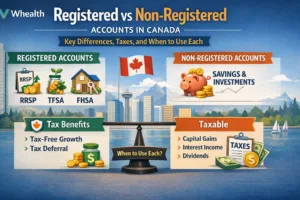
Registered Account Deductions: RRSP, TFSA, and More
Some pay stubs include voluntary deductions that direct a portion of your pay directly into registered accounts. It is important to understand how these differ:
- Group RRSP payroll deduction – reduces your taxable income in the current year; contributions grow tax-deferred until withdrawal
- TFSA payroll deduction – does not reduce taxable income, but growth and withdrawals are tax-free
- Defined Benefit or Defined Contribution Pension Plan – employer-sponsored pension contributions may appear separately from RRSP deductions
For a deeper understanding of how registered accounts work within your overall financial plan, explore our guides on registered and non-registered accounts in Canada.
Quick Reference: Common Pay Stub Deduction Codes
Employers often use abbreviations on pay stubs. Here is a reference guide for common codes:
| Abbreviation | Full Name | Mandatory or Voluntary? |
|---|---|---|
| CPP / CPP2 | Canada Pension Plan | Mandatory |
| EI / QPIP | Employment Insurance / Quebec Parental Insurance Plan | Mandatory |
| FED TAX | Federal Income Tax | Mandatory |
| PROV TAX | Provincial Income Tax | Mandatory |
| RRSP | Registered Retirement Savings Plan | Voluntary |
| GRP BENE | Group Benefits Premium | Voluntary |
| UNION | Union Dues | Voluntary (if applicable) |
| DCPP | Defined Contribution Pension Plan | Voluntary / Contractual |
| LTD | Long-Term Disability Premium | Voluntary |
| CHARITY | Charitable Donation | Voluntary |
Conclusion
Understanding your Canadian pay stub is one of the most practical financial literacy skills you can develop. Every line – from CPP and EI contributions to income tax and group benefits premiums – tells part of the story of where your earnings go and why. Reviewing your pay stub regularly helps you catch errors early, stay aware of your tax situation, and make more informed decisions about registered accounts and workplace benefits.
For employees and small business owners alike, pay stub literacy is a foundation for broader financial awareness. Whether you are exploring group insurance options, considering payroll RRSP contributions, or simply trying to understand your T4, this knowledge puts you in a stronger position to ask the right questions.
Want to explore how investment and insurance options in Canada could complement your financial plan?
Whealth provides access to customized solutions for individuals and small businesses across Canada.
Get started today: Explore Whealth’s financial solutions
This content is for educational purposes only and does not constitute financial, investment, tax, or insurance advice. Always consult a qualified professional for guidance tailored to your personal situation.
Frequently Asked Questions
Find answers to common questions about this topic
Gross pay is the total amount you earn before any deductions are applied. Net pay - sometimes called take-home pay - is what remains after all mandatory and voluntary deductions, such as CPP contributions, EI premiums, and federal and provincial income tax, have been subtracted. The gap between the two can be significant depending on your income level and province.
For 2026, the Canada Pension Plan (CPP) employee contribution rate is 5.95% on earnings between the basic exemption of $3,500 and the Year's Maximum Pensionable Earnings (YMPE). The Canada Revenue Agency updates these figures annually, so it is worth checking the CRA website each year for the current limits. Your employer matches your CPP contribution dollar for dollar.
Your employer may only make deductions that are authorized by law (such as CPP, EI, and income tax), required by a court order, or consented to in writing by you (such as group benefits premiums or union dues). Unauthorized deductions are prohibited under provincial employment standards legislation across Canada.
A TD1 (Personal Tax Credits Return) is a CRA form you complete when you start a new job or when your personal tax situation changes. It tells your employer how much federal and provincial income tax to withhold from your pay. Claiming the correct credits on your TD1 can help avoid being over- or under-taxed throughout the year.
Deductions can fluctuate for several reasons: you may have worked overtime, received a bonus, hit the maximum CPP or EI contribution threshold for the year, or had a change in your group benefits elections. Income tax withholding is also recalculated each period based on your projected annual earnings, so variability is common.
Related Articles