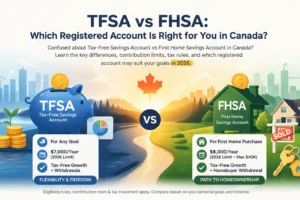
Disclaimer: This article is for educational and informational purposes only. It does not constitute financial, tax, investment, or insurance advice. Contribution limits, eligibility rules, and tax implications are subject to change. Always consult a qualified financial professional and refer to the Canada Revenue Agency for the most current information.
Owning a home is one of the most significant financial milestones for Canadians – but rising home prices have made saving for a down payment increasingly difficult. The First Home Savings Account (FHSA) is a registered account introduced by the Government of Canada in 2023 that combines the tax advantages of both the RRSP and the TFSA to help first-time buyers potentially save more efficiently. According to the Canada Revenue Agency (CRA), eligible Canadians can contribute up to $40,000 over their lifetime, all within a tax-sheltered environment. If you are planning to buy your first home, understanding how the FHSA works may help you save thousands of dollars in taxes and build your down payment more effectively.
Disclaimer: This article is for educational and informational purposes only. It does not constitute financial, tax, investment, or insurance advice. Contribution limits, eligibility rules, and tax implications are subject to change. Always consult a qualified financial professional and refer to the Canada Revenue Agency for the most current information.
TL;DR – Key Takeaways About the FHSA
- Annual contribution limit: $8,000 | Lifetime limit: $40,000
- Contributions may be tax-deductible – similar to an RRSP
- Qualifying withdrawals are generally tax-free for a first home purchase – similar to a TFSA
- Unused contribution room carries forward (up to $8,000 per year)
- Can potentially be combined with the RRSP Home Buyers’ Plan (HBP) for a larger down payment
- If you never buy a home, funds can generally be transferred to an RRSP or RRIF tax-free
- Account must be closed by December 31 of the year you turn 71, or after 15 years – whichever comes first
- Available at most major Canadian financial institutions and investment platforms
What Is the First Home Savings Account (FHSA) and How Does It Work?
The First Home Savings Account (FHSA) is a registered savings plan designed exclusively for first-time home buyers in Canada. It was introduced under the Federal Budget 2022 and became available to Canadians on April 1, 2023.
The FHSA is commonly described as offering a double tax advantage that no other single Canadian registered account provides on its own:
- Contributions may be tax-deductible – similar to an RRSP, meaning they could reduce your taxable income in the year you contribute.
- Qualifying withdrawals are generally tax-free – similar to a TFSA, meaning when you withdraw the funds to purchase your first home, you generally pay no tax on the growth or the original contributions.
This combination makes the FHSA one of the most notable savings tools introduced in Canada for eligible first-time buyers.
To explore all registered and non-registered savings options available to Canadians, visit the Whealth registered accounts overview.
Curious whether the FHSA fits into your home-buying plan?
Whealth offers consultations to help Canadians explore their savings options and understand which registered accounts may align with their goals.
Explore your options with Whealth →
Who Is Eligible to Open an FHSA in Canada?
To open a First Home Savings Account, you must meet all three of the following criteria set by the Canada Revenue Agency (CRA):
- Canadian resident: You must be a resident of Canada for tax purposes.
- Age requirement: You must be at least 18 years old (or the age of majority in your province) and under 71 years old.
- First-time home buyer: You must not have owned a qualifying home that you lived in at any point during the current calendar year or the preceding four calendar years. A qualifying home is generally a housing unit located in Canada.
Important note: If your spouse or common-law partner currently owns a home but you have not personally lived in a home you owned in the last five years, you may still qualify as a first-time buyer under CRA rules.
Always verify your eligibility directly with the CRA or a qualified financial professional before opening an account.
FHSA Contribution Limits: How Much Can You Save?
Understanding the FHSA contribution rules is essential to making the most of the available tax benefits.
| Contribution Type | Amount |
|---|---|
| Annual contribution limit | $8,000 |
| Lifetime contribution limit | $40,000 |
| Maximum carry-forward room per year | $8,000 |
| Maximum contribution in one year (with carry-forward) | $16,000 |
How carry-forward works:
If you open your FHSA in 2024 but only contribute $3,000, you accumulate $5,000 of unused room. In 2025, you could contribute your standard $8,000 plus your $5,000 carry-forward – for a total of $13,000, all potentially tax-deductible. Carry-forward room only begins accumulating in the year you open your account, which is why opening early is often mentioned as an important consideration.
Over-contribution penalty: If you exceed your FHSA contribution limit, the CRA charges a 1% per month tax on the excess amount – the same penalty structure as RRSP over-contributions. Monitor your contribution room carefully using your CRA My Account.
What Are the Tax Benefits of the FHSA?
The FHSA is commonly described as offering three layers of tax efficiency:
1. Potential Tax Deduction on Contributions
Every dollar you contribute to your FHSA may reduce your taxable income for that year. For example, if you earn $85,000 and contribute $8,000 to your FHSA, you would only be taxed on $77,000 of income. Depending on your province and marginal tax rate, this could result in a meaningful tax refund – though actual amounts will vary based on individual circumstances.
2. Tax-Free Growth Inside the Account
All investment growth – interest, dividends, and capital gains – earned inside your FHSA is sheltered from tax while it remains in the account. This allows your savings to compound without an annual tax drag, regardless of the investments you hold.
3. Tax-Free Withdrawals for a Qualifying Home Purchase
When you withdraw funds to purchase your first qualifying home, you generally pay no tax on the withdrawal – not on the original contributions and not on any of the investment growth. This differs from an RRSP withdrawal under the Home Buyers’ Plan, where the funds must eventually be repaid to avoid being added to your taxable income.
For a broader perspective on tax-free growth across registered accounts, explore our guide on how the TFSA works and fits into your overall savings plan.
FHSA vs. RRSP vs. TFSA: Which Account Is Right for a First-Time Buyer?
Many Canadians wonder how the FHSA compares to the Registered Retirement Savings Plan (RRSP) and the Tax-Free Savings Account (TFSA). In most cases, these accounts are designed to complement each other rather than compete.
| Feature | FHSA | RRSP | TFSA |
|---|---|---|---|
| Primary purpose | First home purchase | Retirement savings | Any financial goal |
| Contribution tax deduction | ✅ Yes (generally) | ✅ Yes | ❌ No |
| Tax-free withdrawal | ✅ Yes (qualifying) | ❌ No (taxable income) | ✅ Yes |
| Annual limit | $8,000 | 18% of prior year income | $7,000 (2025) |
| Lifetime limit | $40,000 | No lifetime cap | Cumulative (no cap) |
| Unused room carry-forward | ✅ Yes (max $8,000/yr) | ✅ Yes | ✅ Yes |
| Affects RRSP/TFSA room | ❌ No | N/A | N/A |
A commonly discussed approach for first-time buyers involves:
- Prioritizing the FHSA first for its combined tax advantages specific to a home purchase
- Using the TFSA for flexible savings alongside or after maximizing the FHSA
- Considering RRSP contributions if you are in a higher tax bracket and want to maximize deductions
- Exploring the RRSP Home Buyers’ Plan (HBP) to potentially increase your available down payment – learn more about how the RRSP Home Buyers’ Plan works
If you hold savings outside of registered accounts, it may also be worth understanding how non-registered savings accounts compare to registered options for tax efficiency purposes.
You can also visit the FHSA product page on Whealth for more information on how the account is structured.
How Do FHSA Withdrawals Work?
To make a qualifying tax-free withdrawal from your FHSA, the CRA generally requires that you meet all of the following conditions:
- You are a first-time home buyer at the time of the withdrawal
- You have a written agreement to buy or build a qualifying home before October 1 of the year after the withdrawal
- The qualifying home is located in Canada
- You intend to occupy the home as your principal place of residence within one year of buying or building it
- You complete CRA Form RC725 (Request to Make a Qualifying Withdrawal from your FHSA)
Non-qualifying withdrawals are subject to withholding tax and must be included as taxable income – similar to a standard RRSP withdrawal. It is important to plan your withdrawals carefully and consult the CRA or a qualified professional before proceeding.
Thinking about opening an FHSA and want to understand your options?
Whealth can help you explore registered account information and learn how different accounts may fit your home-buying timeline.
Book a free consultation with a Whealth advisor →
What Can You Invest in Inside an FHSA?
An FHSA can hold a wide range of qualified investments, similar to those permitted in a TFSA or RRSP. These commonly include:
- Cash and high-interest savings deposits
- GICs (Guaranteed Investment Certificates) – lower-risk, fixed-return options
- Mutual funds – professionally managed, diversified portfolios
- ETFs (Exchange-Traded Funds) – typically lower-cost, broad market exposure
- Stocks listed on a designated stock exchange
- Bonds – government and corporate fixed-income securities
Prohibited investments include certain private company shares, debt obligations from a non-arm’s-length party, and investments where the account holder has a significant interest. Holding a prohibited investment can result in a 50% tax penalty – always verify investment eligibility with your financial institution or a qualified professional before investing.
The investment mix you choose inside your FHSA may depend on your home-buying timeline:
| Home-Buying Timeline | Commonly Considered Approach |
|---|---|
| 2–3 years | More conservative options (e.g., GICs, high-interest savings) to help protect capital |
| 4–6 years | Balanced mix of fixed income and modest growth-oriented investments |
| 7–10 years | More diversified, growth-oriented portfolio – though this carries greater risk |
For broader context on registered account investment options, you can also explore other registered accounts designed for specific financial goals.
What Happens If You Never Buy a Home?
Life circumstances change. If you open an FHSA but ultimately decide not to purchase a home, you generally have the following options:
- Transfer funds to your RRSP or RRIF: You can transfer FHSA funds to a Registered Retirement Savings Plan (RRSP) or a Registered Retirement Income Fund (RRIF) without affecting your existing RRSP contribution room. The transfer is not taxed at the time it occurs – you would only pay tax when you eventually withdraw from the RRSP or RRIF in retirement.
- Withdraw as taxable income: You can withdraw the funds and include them in your taxable income for that year. This is generally the least tax-efficient option.
The FHSA must be closed by December 31 of the year you turn 71, or by December 31 of the 15th anniversary year of opening the account – whichever comes earlier.
Illustrative Scenario: How the FHSA Might Be Used in Practice
The following scenario is hypothetical and for educational purposes only. It does not represent actual results, personalized advice, or a guarantee of any outcome.
Imagine a 28-year-old marketing professional living in Mississauga, Ontario, earning $72,000 per year and hoping to purchase her first condo within four years. She has $20,000 sitting in a standard savings account earning minimal interest, and is unclear on how the RRSP, TFSA, and FHSA compare.
The challenge: Her savings are growing slowly, she is paying tax on any interest income earned, and she has no structured plan to build toward a meaningful down payment.
A possible approach: After researching her options, she decides to open an FHSA and contribute the maximum $8,000 per year. She also continues contributing to her TFSA for added flexibility. In year two, she carries forward $8,000 of unused room and contributes $16,000 that year.
A potential outcome: Over four years, she contributes $32,000 to her FHSA and may benefit from tax deductions on those contributions. Combined with RRSP Home Buyers’ Plan funds, she builds a meaningful down payment fund – and approaches her first home purchase with a clearer financial picture.
This type of multi-account approach is one reason financial educators often recommend understanding all available registered savings tools before committing to a single path.
Step-by-Step: How to Open and Potentially Maximize Your FHSA in Canada
Here are commonly referenced steps to consider when setting up your First Home Savings Account:
- Confirm your eligibility – Verify you meet the age, residency, and first-time buyer criteria as outlined by the CRA.
- Open your FHSA early – Available at major banks, credit unions, and investment platforms. Opening your account as soon as you are eligible starts your carry-forward clock, even if you contribute a small amount initially.
- Choose your investments – Consider working with a qualified financial professional to select investments that reflect your timeline and comfort with risk.
- Contribute early in the calendar year – Earlier contributions allow more time for potential tax-sheltered growth within the year.
- Track your contribution room – Use your CRA My Account to monitor your FHSA contribution room and avoid over-contributions.
- Carry forward unused room – If you cannot contribute the full $8,000 in a given year, that unused room (up to $8,000) carries forward to the next year.
- Explore combining with the HBP – When you are ready to buy, consider whether combining your FHSA with the RRSP Home Buyers’ Plan could help increase your available down payment funds.
- Complete CRA Form RC725 – When making your qualifying withdrawal, ensure all CRA paperwork is in order before finalizing your purchase.
Is the FHSA Worth Understanding for Your Home-Buying Plan?
The First Home Savings Account (FHSA) is one of the most significant tax-advantaged tools introduced for Canadian first-time home buyers in recent memory. With up to $40,000 in lifetime contributions that are potentially both tax-deductible and tax-free on qualifying withdrawal, it is a tool worth understanding as part of any first-time buyer’s financial planning process.
The key considerations are opening your account early, selecting investments that reflect your timeline and risk comfort, and understanding how the FHSA can work alongside your TFSA, RRSP, and other savings vehicles.
Whealth provides Canadians with educational resources, consultations, and financial planning support for individuals and small businesses across Canada. Whether you are just beginning to explore your options or are already a few years into your savings journey, understanding the tools available to you early may make a meaningful difference.
Ready to explore whether the FHSA fits your financial goals?
Speak with a Whealth advisor and receive your first consultation for free – no commitment required.
Book your free consultation with Whealth →
This article is for educational and informational purposes only and should not be considered financial, tax, investment, or insurance advice. Contribution limits, eligibility rules, and tax implications are subject to change. Always consult a qualified financial professional and refer to the Canada Revenue Agency for the most current information.
Frequently Asked Questions
Find answers to common questions about this topic
You may still qualify as a first-time home buyer under CRA rules if you have not personally owned and lived in a qualifying home at any point during the current calendar year or the four preceding calendar years - regardless of whether your spouse or common-law partner owns a home. Always verify your specific eligibility directly with the CRA or a qualified financial professional before opening an account.
If you ultimately decide not to purchase a home, you can generally transfer your FHSA funds to an RRSP or RRIF without affecting your existing RRSP contribution room and without triggering tax at the time of transfer. Alternatively, you can withdraw the funds as taxable income, though this is typically the least tax-efficient option. The FHSA must be closed by December 31 of the year you turn 71, or by the 15th anniversary of opening the account - whichever comes first.
Yes. The FHSA and the RRSP Home Buyers' Plan (HBP) can generally be used together for the same qualifying home purchase, potentially allowing first-time buyers to draw from both registered accounts. Under the HBP, eligible individuals may withdraw up to $35,000 from their RRSP tax-free, with the requirement to repay the funds over 15 years. Combining both tools is a commonly discussed approach, though it is important to understand each program's rules before proceeding.
If you do not contribute the full $8,000 in a given year, the unused room carries forward to the following year - up to a maximum of $8,000. This means the most you could contribute in any single year, even with carry-forward, is $16,000. Carry-forward room only begins accumulating in the year you open your FHSA, so opening the account early - even with a small initial contribution - can be beneficial.
An FHSA can hold a range of qualified investments similar to those permitted in a TFSA or RRSP, including cash deposits, GICs, mutual funds, ETFs, stocks listed on a designated stock exchange, and bonds. Prohibited investments include certain private company shares and non-arm's-length debt obligations. Holding a prohibited investment can result in a significant tax penalty, so it is important to verify investment eligibility with your financial institution or a qualified professional before investing.
Related Articles