If you’ve sold an investment – stocks, real estate, mutual funds, or other assets – at a profit in Canada, that profit is likely subject to capital gains tax. According to the Canada Revenue Agency (CRA), capital gains are one of the most common sources of taxable income for Canadian investors, yet many people are unsure how the rules actually work. In 2026, with updated inclusion rates now in effect, understanding how capital gains are calculated and reported is more important than ever for individuals managing their own investments or running a small business.
This educational guide explains how capital gains tax works in Canada, what the current rates look like, how capital gains differ from employment income, and what registered accounts like TFSAs and RRSPs may mean for your tax situation.
Disclaimer: This content is for educational purposes only and does not constitute financial, investment, tax, or insurance advice. Always consult a qualified professional for guidance tailored to your personal situation.
TL;DR – Key Takeaways
- Capital gains tax in Canada applies when you sell an asset for more than you paid for it.
- Only a portion of a capital gain (called the inclusion rate) is added to your taxable income.
- In 2026, the inclusion rate is 50% for individuals on the first $250,000 of annual capital gains, and 2/3 (~66.67%) on amounts above $250,000.
- Capital gains are taxed at your marginal income tax rate – not a separate flat rate.
- Investments held inside a TFSA are generally not subject to capital gains tax.
- RRSP investments grow tax-deferred – gains are only taxed upon withdrawal as income.
- There are legal options that may help reduce capital gains tax, including registered accounts, capital loss harvesting, and exemptions.
- Always speak with a qualified tax professional before making investment or tax decisions.
What Is a Capital Gain in Canada?
A capital gain occurs when you sell a capital property – such as stocks, bonds, real estate (other than your principal residence), mutual funds, or exchange-traded funds (ETFs) – for more than you originally paid for it.
The profit is calculated as:
Capital Gain = Proceeds of Disposition – Adjusted Cost Base (ACB) – Selling Expenses
- Proceeds of disposition = the amount you received from the sale
- Adjusted Cost Base (ACB) = what you originally paid, including any fees or commissions
- Selling expenses = any costs directly related to making the sale (e.g., brokerage commissions)
Illustrative Example (for educational purposes only):
Suppose someone purchased shares in a company for $10,000 and sold them later for $16,000, with $200 in brokerage fees. Their capital gain would be:
$16,000 – $10,000 – $200 = $5,800 capital gain
Only a portion of that $5,800 would be added to their taxable income, based on the applicable inclusion rate.
How Does Capital Gains Tax Work in Canada in 2026?
Canada does not have a separate capital gains tax rate. Instead, a percentage of your capital gain – called the inclusion rate – is added to your regular income and taxed at your marginal tax rate.
The 2026 Capital Gains Inclusion Rate
As confirmed by the CRA and the Government of Canada, the following inclusion rates are applicable in 2026:
| Taxpayer Type | Capital Gain Amount | Inclusion Rate |
|---|---|---|
| Individuals | First $250,000 per year | 50% |
| Individuals | Above $250,000 per year | 2/3 (~66.67%) |
| Corporations & Trusts | All capital gains | 2/3 (~66.67%) |
This means if an individual realizes a $100,000 capital gain in a tax year, only $50,000 is added to their taxable income. That $50,000 is then taxed at whatever federal and provincial marginal rate applies to their total income.
Important Note: Tax rules may change. Always verify current CRA guidelines at canada.ca or consult a qualified tax professional for your specific situation.
Capital Gains vs Income Tax in Canada: What’s the Difference?
This is one of the most commonly searched questions among Canadian investors – and for good reason.
| Feature | Employment / Business Income | Capital Gains |
|---|---|---|
| What it is | Wages, salary, self-employment income | Profit from selling capital assets |
| How much is taxed | 100% included in taxable income | 50% or 66.67% included (inclusion rate) |
| Tax rate applied | Marginal income tax rate | Marginal income tax rate (on included portion) |
| Registered account sheltering | No (employment income is not sheltered) | Yes – TFSA, RRSP, and other accounts may apply |
| Reporting to CRA | T4 slips (or T2125 for self-employed) | Schedule 3 of T1 personal tax return |
In practical terms, capital gains are generally taxed at a lower effective rate than employment income because only a portion is included. However, this advantage is more limited for high-income earners who realize more than $250,000 in capital gains in a single year.
Tax on Selling Stocks in Canada: How Does It Apply?
When you sell stocks held in a non-registered investment account at a profit, the CRA considers that profit a capital gain – and it must be reported on your tax return.
Here is a simplified overview of how it works:
- Calculate your capital gain using the proceeds minus your ACB and selling costs.
- Apply the inclusion rate (50% on the first $250,000; 66.67% above that).
- Add the included amount to your total income for the year.
- Pay tax at your combined federal and provincial marginal rate on that included amount.
Key points to understand:
- You only owe tax on realized gains – meaning you must have actually sold the investment.
- Unrealized gains (increases in value that haven’t been sold) are not taxed.
- If you sell at a loss, that loss can often be used to offset capital gains in the current or other tax years.
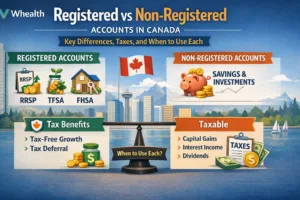
For a broader understanding of how different account types affect your investment income, see our guide on registered vs non-registered accounts in Canada.
How Do Registered Accounts Affect Capital Gains Tax?
One of the most important distinctions in Canadian tax law is how registered accounts treat investment income, including capital gains.
TFSA (Tax-Free Savings Account)
The Tax-Free Savings Account (TFSA) is a registered account where investments – including stocks, ETFs, and mutual funds – can generally grow without being subject to capital gains tax, even when withdrawn. This is one reason the TFSA is widely used by Canadians who hold investments that may generate significant capital gains.
- Contribution room in 2026: $7,000 per year (cumulative room available since 2009)
- Capital gains earned inside a TFSA are generally not taxable
- Withdrawals are generally not added to income
RRSP (Registered Retirement Savings Plan)
The Registered Retirement Savings Plan (RRSP) allows investments to grow on a tax-deferred basis. Capital gains inside an RRSP are not taxed annually. However, when funds are eventually withdrawn – typically in retirement – the full amount is taxed as regular income, not as a capital gain.
- Contributions may reduce your taxable income in the year of contribution
- Investment growth (including capital gains) is deferred until withdrawal
- Withdrawals are taxed as employment-equivalent income
Non-Registered Accounts
Non-registered investment accounts do not offer the same tax sheltering. Capital gains, dividends, and interest earned in these accounts are generally taxable in the year they are realized. However, non-registered accounts also have no contribution limits, which makes them a common option once registered account room has been used.
Legal Options That May Help Reduce Capital Gains Tax in Canada
There are several well-established, legal approaches that Canadians commonly explore to manage their capital gains tax exposure. These are for educational purposes only – always consult a qualified tax professional before taking action.
1. Use a TFSA for Growth-Oriented Investments
Since capital gains inside a TFSA are generally not taxable, holding investments with high growth potential inside a TFSA may help reduce taxable capital gains over time.
2. Use an RRSP to Defer Tax
Contributing to an RRSP allows investments to grow without annual capital gains taxation. This defers the tax event until retirement, when your income (and thus tax rate) may be lower.
3. Harvest Capital Losses
If you have investments that have declined in value, you may choose to sell them to realize a capital loss. Capital losses can generally be used to offset capital gains in the same year, or carried back three years or forward indefinitely under CRA rules.
4. Principal Residence Exemption
If you sell your primary home in Canada, you may be eligible for the Principal Residence Exemption, which can reduce or eliminate capital gains tax on the sale. CRA rules for this exemption are specific and must be followed carefully.
5. Lifetime Capital Gains Exemption (LCGE)
For qualifying small business owners, farmers, and fishing property owners, the Lifetime Capital Gains Exemption may allow a significant portion of capital gains from the sale of qualifying assets to be sheltered from tax. In 2026, the LCGE limit for qualifying small business corporation shares is indexed and has been increased in recent years. Speak to a tax professional to understand eligibility requirements.
6. Spreading Gains Across Tax Years
In some cases, structuring the disposition of assets across multiple tax years – where legally and practically possible – may help keep annual gains below the $250,000 threshold, potentially keeping more of the gain in the lower 50% inclusion bracket.
Illustrative Scenario: Understanding Capital Gains in Practice
The following scenario is entirely hypothetical and presented for educational purposes only. It does not represent actual financial advice.
Imagine a Canadian individual – let’s call her Priya – who has been investing in a mix of Canadian and U.S. equities through a non-registered brokerage account for several years. In 2026, she decides to sell a portion of her portfolio, realizing $180,000 in capital gains.
Because her total capital gains for the year are under $250,000, the 50% inclusion rate applies. That means $90,000 is added to her taxable income for the year.
Meanwhile, Priya also holds some growth-oriented ETFs inside her TFSA. Any gains on those ETFs – regardless of their size – are generally not subject to capital gains tax. She realizes that had she held more of her investments inside her TFSA (within available contribution room), her taxable capital gains could have been lower.
Additionally, Priya had some investments in a technology stock that had declined in value. By selling those shares and realizing a $12,000 capital loss, she was able to offset part of her $180,000 gain, reducing her taxable capital gain for the year.
This scenario illustrates how account structure, capital loss harvesting, and contribution room can all interact with capital gains tax – and why understanding these concepts in advance may be valuable.
Want to learn more about registered accounts and how they relate to tax planning in Canada?
Explore educational resources on investment and registered account options available to Canadians.
Learn about registered account options →
Capital Gains Tax Rates by Province: What to Expect
Because capital gains are taxed at your marginal rate, the total tax you pay depends on both federal and provincial rates. The following table provides an illustrative overview of the combined federal + provincial top marginal rates on capital gains for select provinces in 2026 (applied to the included portion of the gain):
| Province | Top Combined Marginal Rate (on income) | Effective Rate on Capital Gains (50% inclusion) |
|---|---|---|
| Ontario | ~53.5% | ~26.8% |
| British Columbia | ~53.1% | ~26.5% |
| Alberta | ~48.0% | ~24.0% |
| Quebec | ~53.3% | ~26.6% |
| Nova Scotia | ~54.0% | ~27.0% |
Note: These figures are approximate and for illustrative purposes only. Actual rates depend on total income, filing status, and applicable credits. Confirm current rates with a qualified tax professional or at canada.ca.
For individuals with capital gains below $250,000, the 50% inclusion rate applies, making the effective tax rate on capital gains roughly half of the marginal income tax rate – a notable difference from fully-included income sources.
Curious about how registered accounts like the TFSA and RRSP may interact with your investment approach?
Read our educational overview of investment account options in Canada.
Common Misconceptions About Capital Gains Tax in Canada
❌ “Capital gains are fully taxed like employment income.”
✅ Only a portion (50% or 66.67%) is included in taxable income.❌ “You always pay capital gains tax on investments inside a TFSA.”
✅ Capital gains inside a TFSA are generally not subject to tax.❌ “Capital gains tax only applies to real estate.”
✅ It can apply to stocks, bonds, ETFs, mutual funds, cryptocurrency, and other capital property.❌ “You owe tax as soon as your investments increase in value.”
✅ Tax is only triggered when you sell (realize) the gain – not while you still hold the asset.❌ “Capital losses expire at the end of the tax year.”
✅ According to CRA rules, capital losses can be carried back three years or carried forward indefinitely to offset future gains.
Frequently Asked Questions (FAQ)
What is the capital gains tax rate in Canada for 2026?
In Canada, capital gains are not taxed at a separate flat rate. Instead, a portion of your capital gain – known as the inclusion rate – is added to your regular income and taxed at your marginal income tax rate. For individuals, the inclusion rate is 50% on the first $250,000 of capital gains in a tax year. Gains above $250,000 are subject to a 2/3 (approximately 66.67%) inclusion rate. The exact tax you pay depends on your province and total income.
Do I pay capital gains tax when I sell stocks in Canada?
Yes. When you sell stocks or other investments held in a non-registered account and realize a profit, that profit is considered a capital gain and is subject to tax in Canada. However, if those stocks are held inside a registered account such as a TFSA or RRSP, different rules apply – gains inside a TFSA are generally not taxable, while gains inside an RRSP are not taxed until withdrawal.
Is capital gains tax the same as income tax in Canada?
No, capital gains tax and income tax are different in Canada. Employment income is fully included in your taxable income, whereas capital gains are only partially included – currently 50% for the first $250,000. This means capital gains are generally taxed at a lower effective rate than regular employment income, though both are ultimately subject to your marginal tax rate.
Are there legal ways to reduce capital gains tax in Canada?
Yes, there are several commonly used, legal approaches that may help reduce capital gains tax in Canada. These include holding investments inside a TFSA (where gains are generally not taxable), using registered accounts like RRSPs to defer tax, harvesting capital losses to offset gains, using the Lifetime Capital Gains Exemption for qualifying small business shares or farm/fishing property, and the Principal Residence Exemption for your home. Always consult a qualified tax professional before making any decisions.
Does the TFSA protect you from capital gains tax in Canada?
Generally, yes. Investments held inside a Tax-Free Savings Account (TFSA) grow on a tax-sheltered basis, which means capital gains, dividends, and interest earned within the account are generally not subject to tax – even when withdrawn. This makes the TFSA a commonly used registered account for holding investments that may generate significant capital gains.
Conclusion
Capital gains tax in Canada is a topic that affects anyone who invests – whether in stocks, real estate, funds, or other capital property. In 2026, with the updated 2/3 inclusion rate applying to gains above $250,000, understanding how capital gains are calculated and reported has become increasingly relevant for individual investors and small business owners alike.
The most important concepts to understand are: how the inclusion rate determines how much of your gain is taxable, how registered accounts like the TFSA and RRSP may affect your tax exposure, and what legally available options – such as capital loss harvesting and exemptions – are commonly used to manage capital gains.
Because tax rules are complex and subject to change, it is always recommended to consult a qualified Canadian tax professional before making investment or tax-related decisions.
Looking to explore registered and non-registered investment account options in Canada?
Whealth provides educational resources and consultations to help Canadians understand their options.
Book a free educational consultation →
This content is for educational purposes only and does not constitute financial, investment, tax, or insurance advice. Always consult a qualified professional for guidance tailored to your personal situation.
Frequently Asked Questions
Find answers to common questions about this topic
In Canada, capital gains are not taxed at a separate flat rate. Instead, a portion of your capital gain - known as the inclusion rate - is added to your regular income and taxed at your marginal income tax rate. For individuals, the inclusion rate is 50% on the first $250,000 of capital gains in a tax year. Gains above $250,000 are subject to a 2/3 (approximately 66.67%) inclusion rate. The exact tax you pay depends on your province and total income.
Yes. When you sell stocks or other investments held in a non-registered account and realize a profit, that profit is considered a capital gain and is subject to tax in Canada. However, if those stocks are held inside a registered account such as a TFSA or RRSP, different rules apply - gains inside a TFSA are generally not taxable, while gains inside an RRSP are not taxed until withdrawal.
No, capital gains tax and income tax are different in Canada. Employment income is fully included in your taxable income, whereas capital gains are only partially included - currently 50% for the first $250,000. This means capital gains are generally taxed at a lower effective rate than regular employment income, though both are ultimately subject to your marginal tax rate.
Yes, there are several commonly used, legal approaches that may help reduce capital gains tax in Canada. These include holding investments inside a TFSA (where gains are generally not taxable), using registered accounts like RRSPs to defer tax, harvesting capital losses to offset gains, using the Lifetime Capital Gains Exemption for qualifying small business shares or farm/fishing property, and the Principal Residence Exemption for your home. Always consult a qualified tax professional before making any decisions.
Generally, yes. Investments held inside a Tax-Free Savings Account (TFSA) grow on a tax-sheltered basis, which means capital gains, dividends, and interest earned within the account are generally not subject to tax - even when withdrawn. This makes the TFSA a commonly used registered account for holding investments that may generate significant capital gains.
Related Articles